
Flagler County Court Records After a Jail Arrest
After an arrest in Flagler County, the path to a court record runs through several offices. The person is booked into the Sheriff Perry Hall Inmate Detention Facility, where the roster lists the arrest and booking charges. Then the Office of the State Attorney for the Seventh Judicial Circuit reviews the case and decides what to file. The charges the prosecutor files become the court record, and that record is held by the Flagler County Clerk and Comptroller rather than the sheriff.
So there are two sides to keep straight. The booking side, the roster and any booking photo, sits with the sheriff. For the custody and booking detail, see the Flagler County jail inmate records page, and for booking photos see the jail mugshots page. The court side, the formal charges and the case as it moves, is the court record at the heart of the matter. Reading both together gives the full picture of an arrest and the charges that follow.
How to Find Flagler County Court Records After an Arrest
Formal charges and case status show up in the clerk's case-search portal, powered by the Pioneer Technology Group. The arrest and booking detail stays on the jail roster, so the two are checked in different places. The court portal lets you search by a defendant's name or by case number and filter to the right kind of court.
- Open the Flagler Clerk case search.
- Search by name in Last, First format, or by case number if the roster listed a docket.
- Open the case and read the charge list the prosecutor filed.
- Check each charge for its level and current status, and compare it against the booking charges.
The portal also supports date-opened ranges and court-type filters such as Criminal Felony, Misdemeanor, and Criminal Traffic. Submitting a search uses a security check, so it may take a step or two. The case-search page is shown below.
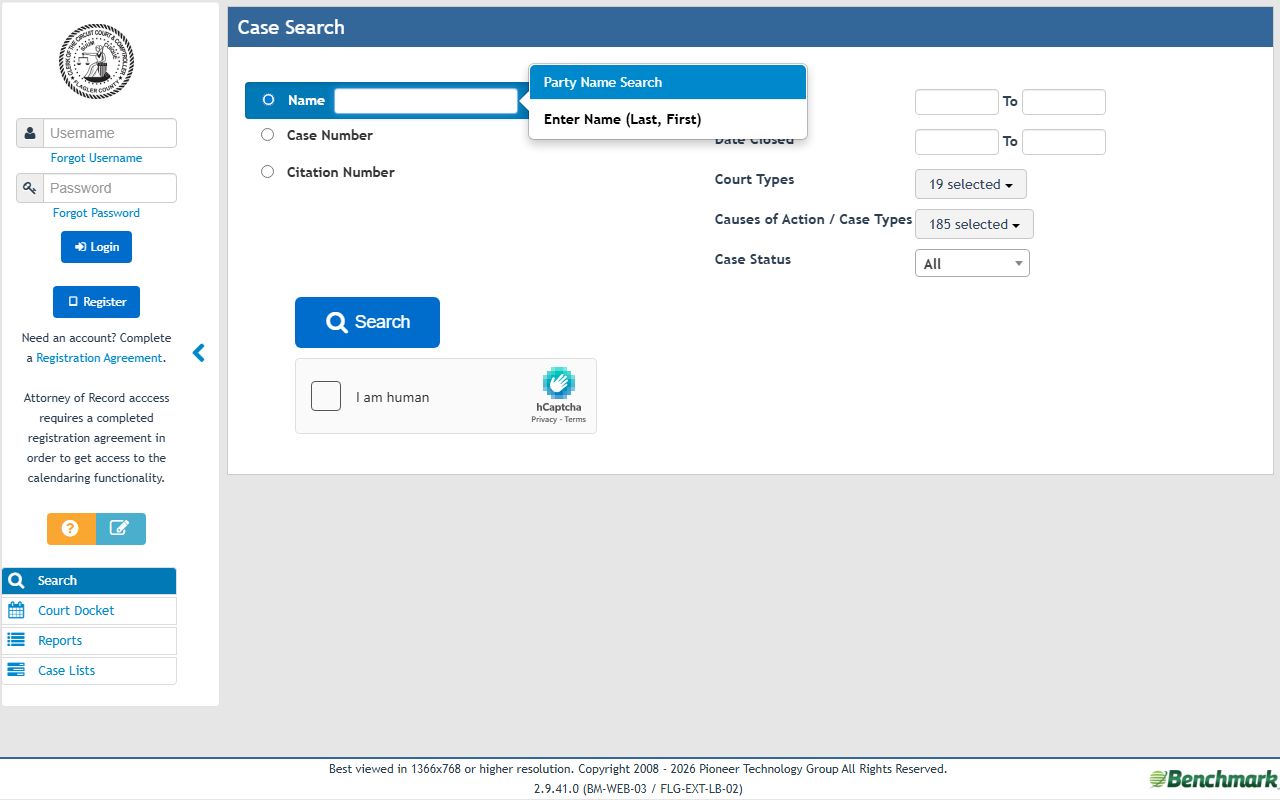
The portal offers two levels of access. Anyone can run a public search, while a registered account, set up through a registration agreement, unlocks enhanced features such as attorney-of-record calendaring. For older files, document images, or restricted access, the clerk's criminal divisions can help by phone: felony at 386-313-4478 and misdemeanor or criminal traffic at 386-313-4474. The courts manager line is 386-313-4378.
How Charges Get Filed After an Arrest: Complaint, Information, and Indictment
The court record begins when a charging document is filed. Booking happens first, at the jail, but the case does not formally open until the charge is on paper in court. In Florida, charges can come three ways. A complaint or sworn document starts many cases, the State Attorney files an information for most felonies, and a grand jury returns an indictment for the most serious offenses such as capital crimes.
| Complaint | Information | Indictment | |
|---|---|---|---|
| Filed By | Officer / Prosecutor | State Attorney | Grand Jury |
| Common For | Misdemeanors | Many felonies | Serious felonies |
| Starts | The case | The case | The case |
Charge Status and What It Means
Charges change as a case moves. The State Attorney may file the same charge the police listed, or amend it, reduce it, add to it, or drop it. That is why a booking charge on the jail roster can differ from the charge that finally appears in the court record. The case-search portal shows a status for the case, such as open, pending, closed, or reopened. The common charge terms are defined below.
| Status | What It Means |
|---|---|
| Pending | The case or charge is not yet fully resolved |
| Amended / Reduced | The prosecutor or court changed the charge or lowered it to a lesser offense |
| Dismissed | The charge ended without a conviction |
| Nolle Prosequi | The prosecutor chose not to pursue the charge |
The Office of the State Attorney for the Seventh Judicial Circuit prosecutes state cases in Flagler County and three neighboring counties. Its homepage is shown below.
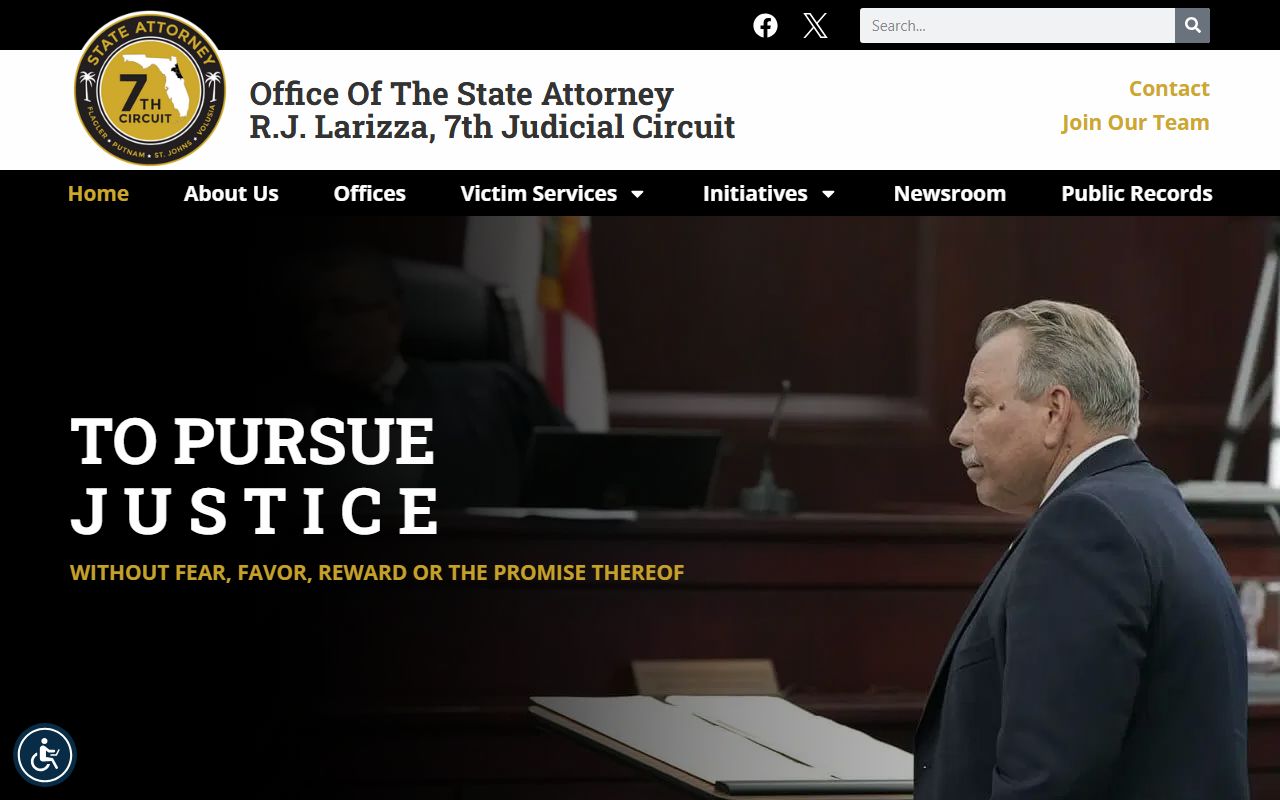
The State Attorney's Office reviews law-enforcement submissions and handles the prosecution; the clerk holds the resulting court record.
Bond and Release After an Arrest
Bond decides whether a person waits for court in jail or at home. A judge sets the amount, or it is read from an established bond schedule, and most but not all charges are bondable. The sheriff's office accepts bonds and cash around the clock and tells families to confirm custody first by calling 386-437-4116 or checking the roster. A hold from another agency can keep a person in custody even after one charge is bonded.
- Cash bond - the full amount is placed with the county and refunded by the clerk if the case ends without forfeiture, less any ordered costs.
- Surety bond - bought through a bonding agency registered with the clerk; jail staff cannot recommend one.
- Credit-card bond - posted online through Access Corrections, the option the sheriff directs families to.
- No-bond hold - serious charges or another agency's hold may block release on ordinary bond.
Warrants That Lead to an Arrest
Many arrests start with a warrant. Flagler County has no standalone public warrant search, so an outstanding warrant or capias usually surfaces through the court case or after the arrest itself shows on the jail roster. The sheriff's Civil Process and Fugitive Unit serves warrants and works with other agencies and the U.S. Marshals to locate wanted people. It is based at 1769 E. Moody Blvd., Building 1, in Bunnell, open weekdays, at 386-313-4340.
For a bench warrant or a court event tied to a warrant, check the clerk's case search and call the criminal division if needed. Do not rely on a website alone to judge warrant status, since not every event is posted, and never walk into a facility without understanding the risk of arrest. Federal warrants are a different track, handled by the U.S. Marshals Service for the Middle District of Florida, whose Jacksonville office can be reached at 904-301-6670.
The State Attorney and Victim Services
The Office of the State Attorney for the Seventh Judicial Circuit, led by R.J. Larizza, prosecutes state criminal cases across Flagler, Volusia, St. Johns, and Putnam counties. After an arrest, this office reviews what law enforcement submits and decides which charges to file, which is why the court record can differ from the booking charges. The local Flagler line is 386-313-4300.
The same circuit runs a victim-services program for people affected by a crime. A Flagler victim advocate, reachable at 386-313-3400, works from the Bunnell justice center campus and can help with case information, court support, and victim-compensation claims. Note: an advocate supports victims through the court process and does not change how a charge is filed or decided.
Charges vs. Convictions
Being arrested and charged is not the same as being convicted. A charge is an accusation that opens the case. A conviction is the result, reached by a plea or a verdict, and it carries a far higher standard of proof. Both can appear in public court records, but they mean very different things.
| Charge | Conviction | |
|---|---|---|
| Stage | Accusation | Verdict or plea |
| Burden of Proof | Probable cause | Beyond a reasonable doubt |
| Public Record | Yes | Yes |
Sealed vs. Expunged Arrest Records
Florida law gives some people a way to clear a record after a dismissal or an eligible outcome. Sealing hides a record from public view, while expunction goes further and treats it as though it never existed. Both run through a court process under state statute, and neither is automatic. The booking photo and roster entry follow the underlying record's status rather than dropping on their own.
| Sealed | Expunged | |
|---|---|---|
| Visibility | Hidden from public view | Destroyed or treated as never existing |
| Law Enforcement | Limited access | Very limited access |
| Statute | Florida Statutes § 943.059 | Florida Statutes § 943.0585 |
The court-ordered process is set out in section 943.059 for sealing and section 943.0585 for expunction.
Background Check Considerations
Court records are public, but using them to judge a person for a job, a rental, or a loan is regulated. A formal background check that meets the Fair Credit Reporting Act comes from a licensed consumer reporting agency, not from a casual public-records lookup. Treat what you find in the clerk's portal as information to verify, not as a screening report.
Important: The information here does not come from a consumer reporting agency under the FCRA and may not be used for employment, tenant, credit, or insurance screening.
Restricted Court Records After an Arrest in Flagler County
Not every record is open. Florida's public records law carries exemptions, and the rules for court files sit in their own statute. Juvenile cases, sealed or expunged charges, active investigations, and certain victim or witness information may be withheld in whole or in part. The clerk and the State Attorney apply these limits when a request reaches a protected record, so an absent file does not always mean a case never existed.
The governing law is worth knowing. General exemptions live in Florida Statutes section 119.071, while the access rules specific to court files and official records sit in section 119.0714. When a record is restricted, the clerk can explain whether it is sealed, exempt, or simply not yet filed, rather than leaving you to guess.